

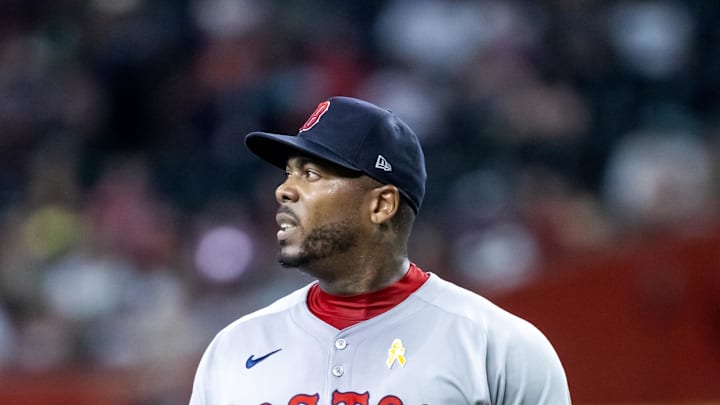
The Boston Red Sox will have a large contingent suiting up to represent various countries when the World Baseball Classic gets underway in a few weeks. Star closer Aroldis Chapman will not be among them.
Chapman is coming off a dominant season that was one of the best of his career, but now at 38 years old, one has to imagine that the Red Sox are breathing a sigh of relief that Chapman is sitting this one out.
The way this came to be might be a surprise. A man nicknamed "The Cuban Missile" will not be participating because he was deemed to "not meet the blood lineage requirements" to pitch for Great Britain. Yup, that's right, Chapman was deemed not British enough to suit up for Great Britain.
The last time Chapman participated in the WBC was for Cuba back in 2009. That makes more sense given what we know, so how is it that Chapman received an invitation to represent Great Britain and ultimately was determined to be ineligible at the eleventh hour? A lot goes into it.
Aroldis Chapman was not approved to pitch for Great Britain in the World Baseball Classic because his lineage-based documentation did not prove eligibility, per @ChrisCotillo
— Talkin' Baseball (@TalkinBaseball_) February 3, 2026
Chapman received an offer from the team in June and planned to accept it pic.twitter.com/tOEQIOA4oC
Why Red Sox star Aroldis Chapman was declared ineligible to play for Great Britain in the World Baseball Classic
It can be fascinating to see which players wind up representing which countries. It's an interesting window into a player's heritage when he winds up playing for a country that you wouldn't expect, for example, Sox reliever Greg Weissert will be representing Italy, despite being born in Bay Shore, New York.
This can happen due to the eligibility process. Essentially, a player can play for any country that he is a citizen of, that he is a legal permanent resident of, or that he was born in. The same conditions apply if one of a player's parents fits that criteria. The last way a player can be deemed eligible to represent a country is if he can present satisfactory evidence that he would be granted citizenship or a passport according to the laws of that particular country.
Chapman tried to qualify for Great Britain under the assertion that his paternal grandparents emigrated to Cuba from Jamaica and that Jamaica was a British colony until 1962. The hold up here is that, even if Jamaica were to qualify as part of Great Britain for these purposes, that link is through his grandparents and not his parents.
According to the rules, Chapman could have represented Cuba; however, after defecting in 2009, he is at odds with the Cuban government and has also stated that he wouldn't play for Cuba despite the fact that he is technically eligible. As a U.S. citizen, Chapman also could've played for Team U.S.A., but by this point, it is too late.
Chapman's attempt to qualify for the British team is a fascinating look into anthropology, history, and biology if you really want to go down that rabbit hole. We won't here, and the WBCI doesn't care to either. The eligibility rules are clear because, as you can see, if there were no limits you could have players claiming all kinds of heritage.
For the Red Sox, this is selfishly for the best. For whatever reason, the club hasn't addressed obvious needs in the bullpen, and Chapman pitching in the WBC would put the pen in unnecessary peril. For Chapman, it's a tough break.
 Add us as a preferred source on Google