

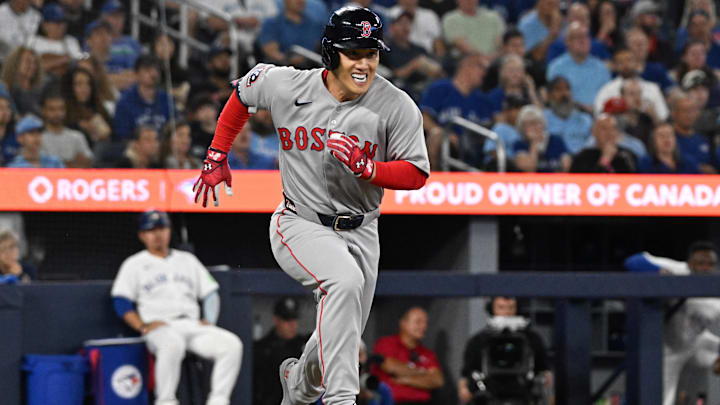
Masataka Yoshida has played a total of 45 innings in the outfield over the last two years for the Boston Red Sox. The vast majority of the time, he was locked in at DH.
As we've been led to understand, that's because the natural outfielder is a butcher defensively, though we've never truly questioned that fact. With his run in the World Baseball Classic over, fans saw something else, however. They saw Yoshida look remarkably good out there with a glove in his hand.
It wasn't just the fans who were pleasantly surprised by the 32-year-old's defense. Yoshida's glove work caught Alex Cora's eye, too.
“The fact that he played the outfield was good for us,” Cora said Monday at JetBlue Park. “It’s actually really good for us. He was moving well. He made some good throws that we saw. In the last game, there were some balls that were hammered in the left-center gap. He got to it, got rid of it. And the at-bats are always good.”
Imagine that. One wouldn't expect a guy with sprint speed in that ranks in the bottom quarter of the league to be a defensive plus in the outfield, but there have been plenty of speedy outfielders who have been net-negatives with the glove and a decent number of plodders who excel through positioning, getting good jumps, and taking the right angles once the ball leaves the bat.
It would be disingenuous not to acknowledge that Yoshida did play 713 1/3 innings in left back in 2023, and turned in a minus-8 outs above average performance. That could dampen the excitement a bit, but there are some possible explanations.
Masataka Yoshida's defensive development gives the Red Sox options, but the logjam still remains
If we assume that Yoshida has truly worked on his defense the past couple of years to improve from his 2023 showing, and has the benefit of being more comfortable in MLB ballparks than he was when he first came over from Japan, it will help give Cora some flexibility.
Despite that newfound flexibility, the outfield logjam that spills into the DH situation still remains. Craig Breslow's steadfast refusal to trade from his outfield surplus makes it hard to envision how at-bats can be evenly distributed among all the worthy contenders.
Yoshida's increased flexibility makes it easier to envision him picking up a few more opportunities at the plate, but it likely won't be enough to give him regular playing time despite Cora's equally complimentary comments about his bat.
If you're an optimist, you see this as only a good thing. It gives Boston options, and it can make multiple pivots and still come out on top. If Yoshida truly is a good defender, and it decides to revisit a trade, it will only increase his trade value. It will also allow the Red Sox to move a different outfielder if they feel that would be the best course of action and not suffer too much in the field.
Maybe another team suffers a major injury and is desperate enough to overpay for a Boston outfielder. Breslow could capitalize, and we'll be glad that he didn't rush to a trade when he had less leverage. Maybe he holds onto the entire group until the trade deadline and is able to score a similar overpay. Or maybe, Yoshida proves to be reliable depth who can save the Red Sox if they suffer an injury of their own.
It's always better to have as many options as possible, and that's where we've arrived with Yoshida showing off this new facet of his game. At some point, the glut will need to be cleared, but this at least buys the club some more time to figure out the best path forward.
 Add us as a preferred source on Google