

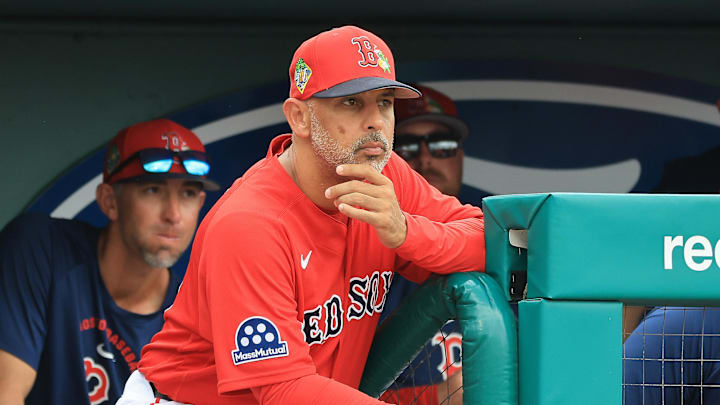
We may never know what caused Craig Breslow, with some sort of backing from Sam Kennedy and John Henry, to pull the trigger on Alex Cora's firing. We've been presented with several potential explanations thus far, but the latest story coming from a Boston Red Sox insider might be the most ridiculous one yet.
The narrative being spun now is that former Red Sox utility man David Hamilton's visit to Fenway as a member of the Milwaukee Brewers earlier this month was the true catalyst that led to Cora's undoing.
Hamilton, ironically, was drafted by the Brewers and arrived in Boston in December of 2021 as part of the Hunter Renfroe trade. He'd debut in 2023 and post a .222/.283/.359 over parts of three seasons with the Red Sox. Apparently, Breslow and a contingent of the front office were upset when the 28-year-old hit .333/.556/.333 during the three-game set in Boston. That looks impressive until you realize that it consisted of just two hits and an 80.4 miles per hour exit velocity over the span.
To the Red Sox, Hamilton's performance solidified the idea that Cora and his staff have repeatedly failed to develop talent. They were high on Hamilton's athleticism and believed the right coaching staff could unlock him. Hamilton has slashed just .234/.355/.250 through 22 games. His 75 OPS+ thus far in Milwaukee is below the 80 OPS+ he posted during his Red Sox tenure.
Red Sox's David Hamilton-driven player development narrative is a poor cover for the real rift with Alex Cora
Bottom line, Hamilton is a pretty generic utility infielder. He's speedy and has a good glove, but he's a light-hitting bat whose offensive philosophy is to slap at the baseball rather than attempt to drive it. There's value to that, but there's also a pretty low ceiling, no matter the coaching staff.
Hamilton is emblematic of the sentiment that Breslow and others apparently held that players always seem to improve after leaving Boston. There are some in the organization who counter that sentiment, pointing to the likes of Rob Refsnyder, Romy Gonzalez, and Jarren Duran as examples to the contrary.
At the heart of the matter seems to be a growing disconnect between Cora and Breslow over the direction of the roster. Cora was at his best when he was leading star-studded rosters. Think 2018 with Mookie Betts, Chris Sale, Xander Bogaerts, and many others who followed the former skipper to a World Series title.
Increasingly, Boston moved towards a team-building method that required efficiency over star power. Henry reined in spending. Breslow had his own sort of evaluation criteria that made sense to him, but to few others. In lieu of stars, the Red Sox were hoping to acquire a group of players with unique traits that would hopefully be maximized, with matchups becoming increasingly more important.
It also led to a lot of youth versus the veteran-laden rosters Cora preferred. That might explain some of Cora's final comments, where he said his job was to teach young guys how to play the game. Rather than a strange evaluation of where the roster currently stands, it might have been a subtle dig at Breslow as tensions bubbled beneath the surface.
Ultimately, this is about Cora's philosophy being incompatible with Breslow's vision, and the organization as a whole siding with the president of baseball operations over the manager. The baffling coaching staff shuffle is Breslow realigning the group with loyalists.
Why else keep pitching coach Andrew Bailey amid the Red Wedding-like scene? The starting rotation has been atrocious with a 4.96 ERA through 28 games. The bullpen has been better, but as a whole, Red Sox pitching has been lacking. But Bailey and Breslow have a long-standing friendship and see things the same way.
It's fine to realize that your manager is not the right guy to lead your team through its current stage in the contention life-cycle. Some skippers excel at developing young talent but struggle with managing veteran personalities. Others are superior tacticians, but struggle in other areas. Even the most balanced ones lean in one direction or another.
To that end, it's fine to say that Cora was no longer the man to lead this current iteration of the Red Sox because of the skills required to maximize the collection of talent. But to suggest that a three-game showing from a 28-year-old career bench player was the reason he needed to be let go isn't just ridiculous; it's dishonest.
 Add us as a preferred source on Google