

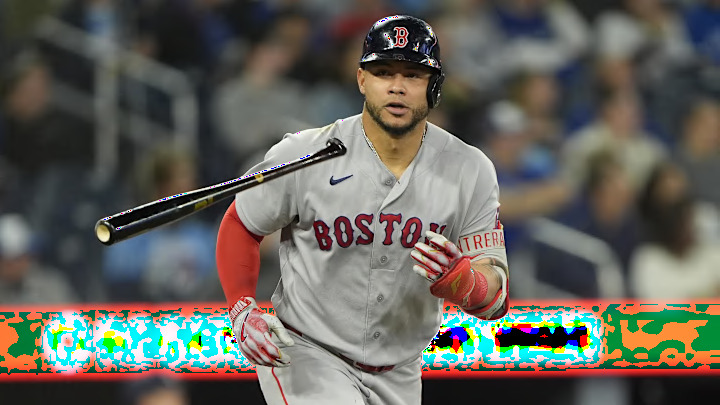
The Boston Red Sox were one of the most active teams over the 2025-26 offseason, but they didn't make many of the moves experts and analysts expected of them. Alex Bregman walked and all other experienced sluggers went unsigned as chief baseball officer Craig Breslow tripled-down on run prevention.
Some of Boston's offseason decisions have proven fruitful a quarter of the way into the season, while others haven't panned out as well (as is the case with any offseason). Here' we'll break down the Red Sox's best and worst offseason choices that helped them get where they are today — in and out of last place in the American League East after the shocking early firing of their longtime manager
3 Red Sox offseason decisions that look genius
Trading for Willson Contreras
Willson Contreras wasn't who many Red Sox fans had in mind when they imagined the list of big hitters who could join their favorite team, but he's been everything Boston has needed and more, so far. The catcher-turned-first baseman has brought defensive stability — even defensive excellence — to the corner, which the Red Sox have lacked for years.
Contreras has also been one of Boston's best hitters so far, helping to keep the Sox afloat while other hitters struggle. The veteran is slashing .259/.380/.467 with a team-leading eight home runs through 39 games. Contreras' fiery personality and leadership have also helped the Red Sox get their energy up after an ugly start to the year.
Signing Ranger Suarez
During the offseason, the Red Sox probably wouldn't have predicted that Ranger Suarez would be their best pitcher through the first quarter of the season, but he's been exactly that. While Garrett Crochet has struggled and dealt with injuries and with Sonny Gray and Johan Oviedo on the sidelines, Suarez held the rotation down for Boston.
Suarez has a 2.44 ERA, a 0.95 WHIP, 40 strikeouts and 11 walks over 44.1 frames. He's been untouchable since April 27 and hasn't allowed a run in his last three starts. So far, he's been well worth the five-year deal the Red Sox gave him (subscription required).
Not trading Connelly Early or Payton Tolle
The Red Sox were involved in trade discssions for plenty of players they never ended up with, including Ketel Marte and Isaac Paredes, to name a few. In some of those trade discussions, teams coveted top young pitching prospects Connelly Early or Payton Tolle. Thankfully, the Red Sox held firm and kept them both.
Early and Tolle have been two of the most consistent arms in Boston's rotation, with 3.16 and 2.78 ERAs, respectively. In a young season with plenty of pitcher injuries and one during which Crochet hasn't looked as sharp as he did a year ago, the two recently-graduated top prospects have been indespensible. They've either cemented themselves as staples on the Sox's roster or raised their trade value exponentially.
3 Red Sox offseason decisions that look awful
Building the team on 'run prevention'
Breslow emphasized improving Boston's pitching over the offseason to limit as many runs from scoring as possible, and it's safe to say he's done that. The Red Sox lead MLB with 40 defensive runs saved and their starters have a 2.76 ERA since April 25.
But preventing runs doesn't mean much if the offense can't score enough to make up for the one or two that slip through the cracks. The Red Sox average 3.7 runs per game, tied for the second-lowest in MLB, which isn't enough to win on a regular basis. Fenway Park is known for its friendly dimensions, and not taking advantage of that with a strong offense has been Boston's absolute biggest mistake.
Not signing a slugger
Just as building this year's Sox team on run prevention was a bad idea, not signing or trading for a home run hitter this offseason was roster building malpractice by Breslow. The Red Sox sorely missed Rafael Devers' power after trading him last year and didn't learn their lesson.
Boston's 31 home runs are tied for the second-fewest in the league, it has the second-lowest slugging percentage (.354) and the fourth-lowest OPS (.667). Red Sox hitters also don't get on base reliably enough (.313 on base percentage) to string multiple hits together to score runs. Having a home run hitter to score any of the dozen runners the Red Sox leave on base per game would make a world of difference.
Keeping Jarren Duran
The Red Sox entered this season with five outfielders on their roster and left themselves in an impossible lineup-building situation. Boston had been receiving interest in a Jarren Duran trade from multiple teams, but it decided to hold onto him to its own detriment.
Duran has been one of the Red Sox's most disappointing performers at the plate this season. He's batting .178/.233/.296 through 38 games. He has the lowest batting run value in the league. He's tied with Caleb Durbin for the third-lowest WRC+ in the league (43). His trade value has been dragged down to almost nothing and he doesn't have the execution or personality to be a leader on this team.
The best time to trade Duran passed at least a year and a half ago. Now, the Red Sox are stuck with a logjam that's preventing them from playing their best hitters every day.
 Add us as a preferred source on Google