

The Boston Red Sox had to upgrade at first base this offseason. After running out a motley crew of fill-ins that consisted of Abraham Toro, Romy Gonzalez, Nathaniel Lowe and others in 2025, finding a full-time starter with middle-of-the-order credentials was a necessity.
Of course, those fill-ins were only necessary because the team's original answer at the cold corner, Triston Casas, suffered yet another injury. This one, a ruptured left patellar tendon, ended his season in early May after just 29 games.
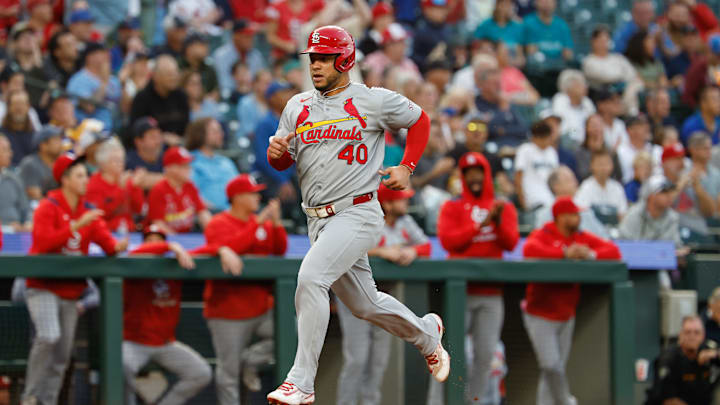
Thankfully, Craig Breslow and the front office took that call to action to heart, and in their second trade of the offseason with Chaim Bloom and the St. Louis Cardinals, they brought in Willson Contreras.
The 2016 World Series champion hit .257/.344/.447 (124 wRC+) with 20 home runs, marking the fourth time in the past five seasons that he cleared the 20-homer threshold. His right-handed bat will be a welcome presence in the middle of Alex Cora's lineup, though as the clear-cut starter at first base for the next two seasons, it's becoming harder and harder to imagine where Casas fits into the Red Sox's puzzle.
Triston Casas' final stand with Red Sox has arrived with Willson Contreras
After bursting onto the scene and finishing third in the American League Rookie of the Year race in 2023, Casas has simply been unable to stay healthy in recent seasons. No injury has been more severe than the leg injury he suffered this time around, to the point that his status for Opening Day 2026 remains uncertain.
Problematically, even before his injury, Casas was really going through it at the plate this year. He hit .182/.277/.303 (56 wRC+) while walking less than ever. And though he still provided impact when on the field in 2024, he struck out in more than 31% of his plate appearances that season. The 25-year-old is hardly infallible when he is healthy.
Now, none of this is to suggest the Red Sox would be wise to give up on Casas just 251 games into his MLB career. But the fact that he's only played that many games in three seasons and change is just a level of unreliability that can't be counted on — hence why the team acquired Contreras.
In terms of future paths to playing time, the designated hitter spot is still unaccounted for on a full-time basis, though we know Cora loves to keep rotating players through that spot. Plus, Casas would have to prove his left-handed bat is more impactful than whichever of Roman Anthony, Wilyer Abreu, or Jarren Duran isn't playing the field on a given night.
And because Contreras is a superior defender at the cold corner, Casas can't really be expected to demand playing time thanks to his glove. Reserving him for a true bench role or as a pinch hitter feels like a waste of his talents, but it's hard to figure out exactly where else he fits on the roster.
It's possible that we've already seen the last of Casas starting in Boston. A trade feels unlikely — his value is at a nadir after all these injuries — but so too does the possibility of Casas reemerging as a key part of the Red Sox's core.
 Add us as a preferred source on Google