

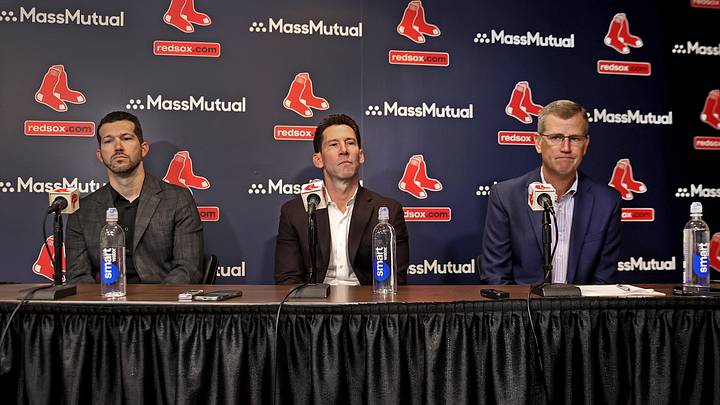
The Boston Red Sox on October 5 officially put the 2026 season behind them with their end of season press conference. The men in charge in Boston gave the usual message of disappointment that their playoff run wasn't longer and that they'll put in the work to improve the team for next year.
Team CEO and President Sam Kennedy made sure to note that "it was an amazing atmosphere night in and night out" at Fenway Park this season, and while that comment might seem innocuous, it made us think. After the team's rocky start, some boos, paper bag hats and "sell the team" chants, Fenway went back to selling out every night, which ownership is banking on.
More and more baseball fans are catching on to a strategy that many small market owners, and seemingly Red Sox and Fenway Sports Group owner John Henry, use to make as much money as possible off their teams. The Red Sox have their own TV network, NESN, partially owned by Henry — when the Sox win, subscriptions and viewership go up. Fenway Park is one of the smallest in MLB, so when the Red Sox play well, the competition for tickets increases, as do the prices.
Boston's front office has seemingly realized that the Red Sox don't need to be a superteam, or even a deep playoff contender, to sell tickets. Since last winning the World Series in 2018, the front office has scaled back spending on the roster. The Red Sox have traded away many of their star players (Mookie Betts, Rafael Devers and Chris Sale, to name a few) and let impending free agent walk (Xander Bogaerts, Kyle Schwarber, Alex Bregman) to save a buck.
Sam Kennedy end of season press conference comment brings attention to Red Sox offseason strategy
Yet, the team can still go on a run or two every year to stay in the playoff mix, just long enough to keep fans invested and the seats full at Fenway. After missing the playoffs in five of the six years from 2019-24, the Red Sox have been putting more effort into their free agent and trade pursuits, but not enough to make a difference in October.
Letting Bregman walk after trading Devers to accommodate him was a choice. Even when the front office knew Bregman had a better offer elsewhere, it chose not to increase its own. Not signing Schwarber or Pete Alonso to bring real, consistent, game-changing home run power to the team was a choice. Unfortunately, they were all made in the interest of saving money.
This isn't to say that Willson Contreras, Ranger Suarez and Boston's other 2025-26 offseason adds aren't great players, but they don't have the championship pedigree Bregman carries or the consistency he, Alonso and Schwarber bring to an offense. That star power comes at a premium Henry and FSG are no longer interested in paying because the seats in his ballpark will be full, regardless. The Devers trade and Bregman whiff show they're not even trying to hide it anymore.
Of course the atmosphere at Fenway was great, it almost always is. Boston is a baseball town at heart and when the Sox are playing there will always be thousands of fans in building, whether they be tourists or die-hards.
Keeping Fenway Park sold out is seemingly the front office's main goal. The 2026 roster wasn't built with championships in mind when the competition around the league includes the Los Angeles Dodgers and New York Yankees, and when the clearest deficiency from 2025 (a complete inability to consistently hit home runs) went unaddressed. The same deficiency persists into the 2026-27 offseason — now we have to see if the Red Sox fix it or follow the pattern of the past few years.
 Add us as a preferred source on Google