

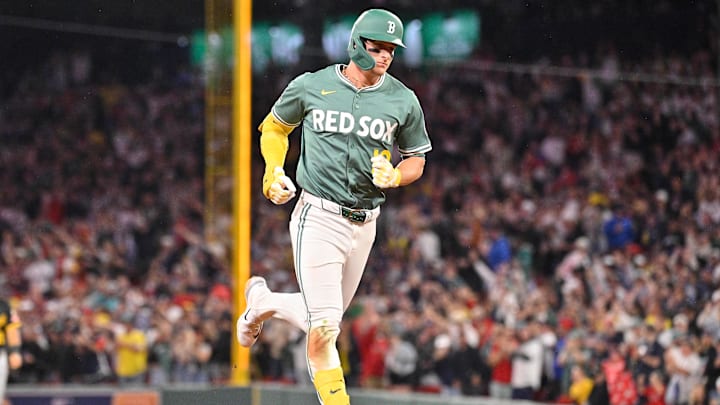
The Boston Red Sox haven't batted 1.000 when it comes to their recent contract extension decisions. They waited too late to extend Wilyer Abreu (and now won't), and they may have made a mistake in extending Kristian Campbell (the jury is still out).
But Boston appears to have hit a home run with the extension it locked in with Roman Anthony. Anthony's eight-year, $130 million deal (with significant escalators) will look like a bargain pretty soon if he continues to flash the star power he showed off for much of 2025 and throughout the World Baseball Classic.
Anthony's deal had an impact on the rest of MLB, too. It's become the standard by which each club measures its own extensions offered to its young superstar/potential franchise cornerstone. We saw this with both Konnor Griffin's Pittsburgh Pirates extension and Kevin McGonigle's Detroit Tigers extension.
Griffin signed for nine years, $140 million on April 8, nearly mirroring Anthony's deal. Exactly a week later, the Tiger and McGonigle agreed to an eight-year, $150 million pact. Anthony's extension —signed on August 6, 2025 — was clearly the blueprint for both Griffin's and McGonigle's deals.
Pirates, Tigers used Roman Anthony's Red Sox extension as blueprint
Kevin McGonigle has agreed to an eight-year, $150 million extension with the Tigers, per @ByRobertMurray
— Baseball America (@BaseballAmerica) April 15, 2026
That's the biggest extension signed by a prospect ever.
He broke Konnor Griffin's record ($140 million) from a WEEK ago. pic.twitter.com/xOSxNYVvgZ
There's a reason these specific types of extensions are a popular move for MLB franchises. When you have a player as obviously talented as Anthony, Griffin, or McGonigle, you're in line to have to pay that guy a monstrous, Juan Soto-type contract once they hit free agency, provided they've fulfilled their incredible potential.
As soon as a given MLB club determines that its young, budding superstar is indeed likely to reach their ceiling (well beyond a reasonable doubt), it makes a ton of sense to sign them now for way less money than they'd be in line for after their original contract ends.
From the player's perspective, you can argue that they are leaving a gargantuan sum of future cash on the table by signing these deals. But keep in mind that a player could suffer a career-altering injury on any play. Anthony, Griffin, and McGonigle signed these deals because they guaranteed that they bag generational, life-changing money, regardless of what ill fate might befall them at the start of their careers. In essence, it's a huge safeguard against injury risk, and a wise one at that.
The Red Sox aren't afraid to offer these extensions, that's for sure. Who will be next? Carlos Narváez? Marcelo Mayer? As aforementioned, Boston's front office hasn't nailed all of these decisions, but it's sure among the leading trendsetters in MLB when it comes to constantly considering these extensions, and in many cases, pulling the trigger.
 Add us as a preferred source on Google