

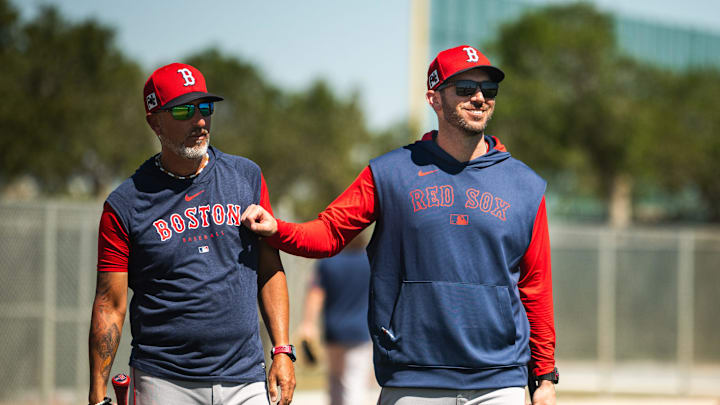
Offense — alongside many other things — hasn't been the Boston Red Sox's strong suit to start the 2026 season. A month in, Boston ranks in the bottom three in the league in team OPS, second-to-last in home runs, it has the seventh-fewest runs scored and a -16 run differential.
The Red Sox hope to address these issues with shocking, sweeping managerial and coaching staff changes very early into the season. They had two games of solid results before reverting back to their old ways in the second and third games of their series against the Toronto Blue Jays.
It's far too early to place any blame on Boston's new coaches, but Buster Olney has theorized that a change in some coaching rules could be part of its offensive downfall. First and third base coaches are now being forced to stand in their designated boxes on their respective sides of the field during game action.
The boxes were more like a suggestion in years past, but umpires are now expected to enforce that first and third base coaches stand in the designated area. This is to prevent the coaches from getting a glimpse at pitchers' grips on the mound which should limit their ability to relay signs to the batter at the plate.
Buster Olney partially attributes Red Sox's early offensive struggles to newly enforced first/third base coach rules
According to Olney, other teams have noticed that Red Sox first and third base coaches — formerly Jose Flores and Kyle Hudson — were very skilled at seeing grips. Last year, Flores got into a pregame tiff with Los Angeles Angels pitcher Tyler Anderson, who believed he saw the first base coach ripping signs off him. The Red Sox chased Anderson from the game in the fifth inning and ended up winning, 11-8.
Players and coaches relaying signs during games is not illegal, provided they're deciphered in the moment and without any external technology. Runners on second base can often see pitchers' grips inside their gloves and they're allowed to show the hitter at the plate what's coming. Former Houston Astros pitcher Hector Neris called Trevor Story out for doing so last season, despite the legality of the action.
The first and third base coach rule can't be blamed for all of Boston's 2026 offensive failings — not every pitcher has obvious tells about which pitch is coming, and players knowing which pitch they're about to see doesn't guarantee success (although it probably greatly increases it). In baseball, players and coaches will seek out any advantage they can get and relaying signs is a relatively easy and legal one.
Poor swing decisions have been one of the Red Sox's most severe issues to start the year. Surely some might attribue this to the first and third base coach rules, but Boston's general lack of experience due to the team's young average age and poor roster construction are also key factors.
 Add us as a preferred source on Google