

The Butterfly Effect is a funny thing — change one thing in history, and who knows what the present looks like? Sports butterfly effects are very fun to think about, and the Boston Red Sox seem to be on the right end of one.
Back in 2007, the then Florida Marlins were in a financial bind. They had a lease with Dolphin Stadium in Miami, but were only receiving a percentage of the concessions, parking, and ad revenue from the stadium. Those factors, plus the fact that they had low attendance due to them playing in a stadium not built for baseball and general distrust from the fanbase, meant that they were running into financial problems. They were hoping for funding for a new stadium, but it wasn't making it through the Florida Senate, so they decided they needed to trade away increasingly expensive players.
On December 7, 2007, the Marlins dealt Miguel Cabrera and Dontrelle Willis to the Detroit Tigers. Cabrera was just 24 years old, had been to four straight All-Star games, had two Silver Sluggers, and a ring to his name. Willis was coming off a rough '07 season but had been a Cy Young runner-up just two years prior, and had been worth 17.2 bWAR in his five years in Florida. Headed the other way were outfielder Cameron Maybin, catcher Mike Rabelo, and pitchers Burke Badenhop, Dallas Trahern, Frankie De La Cruz, and Andrew Miller.
Of course, for Red Sox fans, Andrew Miller stands out, but it would be a few years until he made it to Boston. The lefty was a Tigers first-round draft pick in 2006 as a starting pitcher and was one of the headlining pieces of the deal. Miller spent three tumultuous years in Vice City, posting a 5.89 across 41 starts and 58 total games.
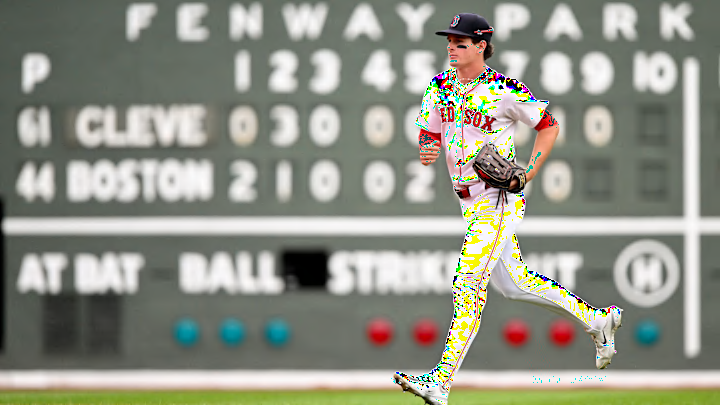
A winding chain of events between the Red Sox, Tigers and Marlins led to Boston's eventual selection of Roman Anthony in the 2022 MLB Draft
By the end of 2010, Miller was out of options for the Marlins, and while he could have been non-tendered, the Red Sox decided to take a chance on him. On November 12, 2010, the Sox swapped Dustin Richardson, a lefty reliever who had pitched 16 1/3 innings for Boston between 2009-10, for the southpaw.
Boston tried Miller mostly as a starter in 2011, and it still wasn't working. He had a 5.54 ERA in 17 appearances, 12 of which were starts. In 2012, the then-27-year-old transitioned to a full-time bullpen role, and it was successful. He had a 3.35 ERA in 53 appearances and had his best season by bWAR. In 2013, Miller started the season superbly, with a 2.64 ERA in 37 relief outings, but a left foot injury in early July ended up costing him the season after he underwent surgery.
Miller picked up right where he left off in 2014. He had a 2.34 ERA in 50 games in Boston, but the Sox's fall off left Miller on the trade block, and he was dealt to the Orioles at the deadline for a 21-year-old prospect named Eduardo Rodriguez.
Rodriguez made his MLB debut for Boston 10 months later in late May 2015. The southpaw pitched in Boston from 2015-21, while sitting out the COVID season. He made over 230 starts for the Sox, pitched over 1300 innings, and had an ERA of 4.16. His best season in Boston was 2019, where he had a 5.5 bWAR, 3.81 ERA, pitched over 200 innings, and finished sixth in the Cy Young voting.
Following 2021, ERod became a free agent. The Red Sox extended him the qualifying offer, which he declined, instead opting to sign a five-year, $77 million deal with Detroit. Of course, the Sox got a compensation pick in the 2022 draft. It ended up being the 40th pick of the second round, pick 79 overall. With that selection, the Red Sox took Roman Anthony.
Three seasons later, Red Sox Nation was able to see Anthony make his long-awaited MLB debut as the No. 1 prospect in baseball. It was an extremely impressive first season for the 21-year-old, and now fans are turning to him to bring them back to the World Series.
It was a long and winding chain of events that led to Anthony landing with Boston. How many things could have gone differently in the 14 years before Anthony was drafted by Boston? Four different trades, a compensation pick, and even a Florida Senate veto— one small change could have changed Red Sox history.
 Add us as a preferred source on Google