

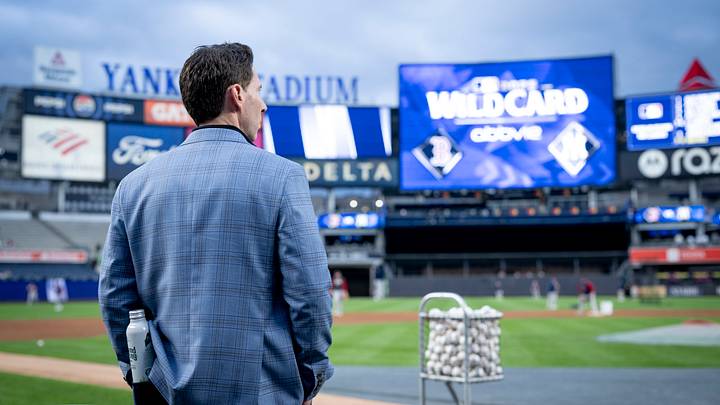
The Boston Red Sox on October 5 officially closed the book on the 2026 season with their postseason press conference. A meeting usually characterized by promises for substantial offseason action took a slightly different tone this year (partially due to impending labor disputes casting a dark cloud over the start of the 2027 campaign).
Despite being eliminated by their arch-rival New York Yankees for the second year in a row, the Red Sox's leaders didn't assert that massive offseason additions were coming or that sweeping changes would improve the lineup. Chief Baseball Officer Craig Breslow noted expected internal improvements as solutions for the lineup alongside external adds.
"I have no doubt that if Roman Anthony got 600 at-bats we would see well above average offensive performance and Curtis Mean, again, well on his way...," Breslow said. "There are a lot of reasons to believe that the existing offense should be better in 2027, we're also going to do everything we can to find ways to improve beyond that."
Little about Boston's offense inspires confidence that the pre-existing lineup can improve enough to get the team through next season. The Red Sox had their lowest-scoring season since 2014, and by a significant margin, scoring 97 fewer runs than they did last year. While improvement is possible, it isn't guaranteed, especially under a manager and coaching staff that hasn't billed a year in the big leagues yet.
Red Sox banking on offensive improvement from young players is an inherently flawed method of roster building
Banking on internal improvements to the offense is how the Red Sox got to where they are in the first place. While it would be nice to see a full season of consistent offseason output from Anthony, he hasn't proven that he can deliver at the big league level. Jarren Duran's presence at the plate certainly didn't compensate for the loss, and he's an example of how expecting consistent growth from improving players can backfire. Down years can come at any time.
Ceddanne Rafaela and Wilyer Abreu have already made offensive jumps. Rafaela improved his contact rate with 18 more hits than last season in 18 fewer games. Abreu hit a career-high 24 home runs and his 38 doubles ranked second-most in MLB. Rafaela could afford to cut down his 45.3 chase percentage which ranks in the first percentile, but high chase rates have always been part of his game. Abreu was about as streaky this year as he was last year.
Mead's breakout just started in 2026 and lasted just over half a season before he fell injured. His 17 home runs and .851 OPS over 88 games look great on paper, but he's never approached anything close to that output before 2026.
Hoping for continued improvement from young players is not a proven way to win. Player improvement isn't guaranteed, and even if they do make a jump, they could get injured and send their spot in the lineup back to square one. If the roster requires every hitter to constantly operate at their peak or at levels the Red Sox have never seen before in order to be successful, its construction is flawed.
Boston's need for an impact bat still persists and it should be one of the club's highest priorities this offseason. While it would be nice to bank on Anthony or Abreu to grow into the home run hitter the Sox need, it will take a lot of improvement for that to be the case. So far, neither player, nor Rafaela nor Mead, has shown they have the skillset the Red Sox need to perform better than they have in the last two seasons.
 Add us as a preferred source on Google