

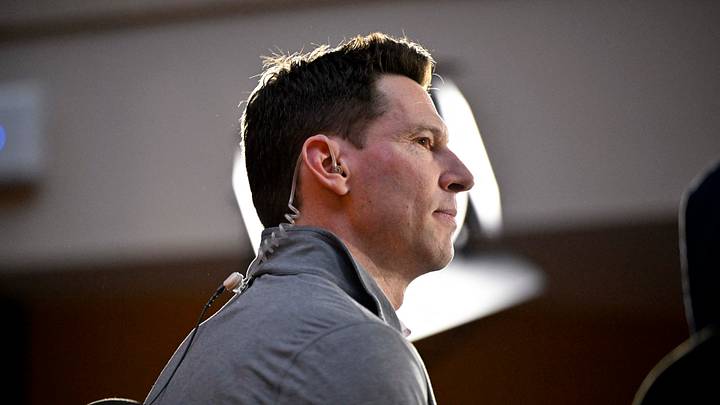
MLB analysts have been throwing around the idea that Boston Red Sox President of Baseball Operations Craig Breslow's hiring was supposed to be like the development of a prospect. That he was very raw and inexperienced when the Red Sox made the decision, and that there would be a learning curve, similar to the way some prospects develop once they reach the majors.
Some fans rebuffed that idea. A few too many missteps in his first couple of years at the top led some to think that he just wasn't right for the job, and he was either going to be able to do it well, or he wasn't. The Red Sox's signing of Jake Bauers may have proved that theory right.
Bauers became the first major domino to fall in the 2026-'27 offseason, signing a four-year, $58 million contract with Boston. Some will look at the team-building side of this signing and have serious questions, and those will only go away once Breslow addresses other aspects of the roster. The part of the signing that shows Breslow's development is the structure of the deal.
Craig Breslow adding Jake Bauers to Red Sox is something veteran executives do
The full structure of Jake Bauers’ 4-year, $58 MM deal with the Red Sox ⬇️
— Tyler Milliken (@tylermilliken_) November 13, 2026
2027: $16 MM
2028: $16 MM
2029: $15 MM
2030: $11 MM
Interesting to see more money up front. Not backloaded like Ranger Suarez’s deal. Makes it easier to move down the line.
(via @alexspeier) pic.twitter.com/SWYQOxFR7Y
With Bauers heading into his age-31 season, Breslow was able to get him to agree to a frontloaded deal. According to Alex Speier (subscription required) of The Boston Globe, the left-handed first baseman will make $16 million in years one and two of the deal, $15 million in year three, and $11 million in the final year. That is a brilliant bit of business on Breslow's part.
This will greatly improve the Red Sox's ability to trade Bauer closer to the end of the deal. If the Sox do want to trade him, the team taking him will be taking less money if the deal was split evenly between the years or backloaded. Whether it's hard cash, from an AAV standpoint or a luxury tax hit standpoint, it'll help make Bauers more attractive in his latter years.
It's an excellent way to structure a contract while also keeping the future in mind. While, obviously, the hope is that the Red Sox are competitive across the life of the contract and even longer, on the chance that they aren't, this will provide some flexibility.
This is the type of signing that veteran baseball executives make. Of course, most players don't accept deals like this, but finding a player who will, and actually getting them to sign on the dotted line, is proof of Breslow's growth and development.
It's a small step in the offseason, and there are plenty of other moves that need to be made before the Red Sox roster is complete and fans can give Breslow his plaudits. But the signing is a victory, and the contract structure is an added bonus that should have Red Sox fans feeling a little more optimistic about their President of Baseball Operations.
 Add us as a preferred source on Google