

The 2026 MLB Draft arrives July 11, and the Boston Red Sox are on the clock at pick 20 with a $4,373,900 slot value. To appreciate who Boston might take, it helps to understand why it's picking there, and what this organization genuinely needs.
Under the current CBA, each pick inside the first 10 rounds carries an assigned slot value, and the sum of those values creates each team's total bonus pool. Teams can exceed that pool by up to 5% without penalty — no club in draft history has ever crossed that line — and going over triggers forfeited future picks.
Five teams had their first-round picks penalized 10 spots this year — the Yankees (pick 35, $2,826,700), Phillies (pick 36, $2,758,800), Blue Jays, Mets, and Dodgers (pick 40, $2,504,200) — all for exceeding the second CBT surcharge threshold. The Red Sox avoided that penalty and carry a full $8,219,200 bonus pool, though they forfeited their second-round pick for signing a qualifying offer free agent, making pick 20 effectively their first two selections combined.
A year ago, Boston had the consensus No. 1 farm system in baseball. Roman Anthony, Marcelo Mayer, and Kristian Campbell have all since graduated to the majors, leaving a system Keith Law of The Athletic now ranks 10th: "a pitching development powerhouse" that has done "an interesting 180" from its former hitter-heavy identity (subscription required). Seven of their top 10 prospects are pitchers, and Franklin Arias is the only position player in the top 200 in baseball.
The need is clear: impact offensive talent, both in the farm and on an MLB roster sitting at the bottom of its division with a recently fired manager. And with five first-rounders from the 2024 class already in the big leagues within a year of being drafted, a polished college bat or premium arm at pick 20 could realistically be in Boston by 2028, maybe even 2027.
Here are five prospects linked to Boston at pick 20 across multiple mock drafts, and why each one fits this organizational moment.
5 2026 MLB Draft prospects Red Sox fans should know
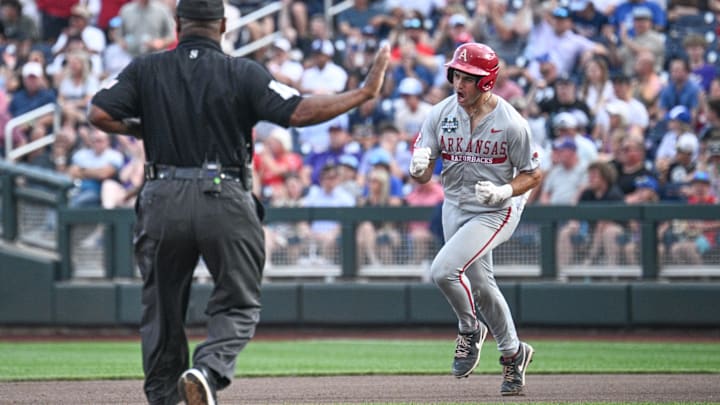
Ryder Helfrick, C — Arkansas Razorbacks (SEC)
Hometown: Concord, California | BA Staff Mock 2.0: Pick 20 to Boston
Helfrick is a 6-foot-1, 205-pound right-handed catcher who has emerged as the second-best backstop in the class behind Georgia Tech's Vahn Lackey. His sophomore breakout at Arkansas — .305/.420/.616, 15 home runs, 38 RBI — earned him a spot on the USA Baseball 18U National Team, and this spring he's continued to produce: .297 with 14 home runs and 40 RBI against SEC pitching. He brings plus bat speed, pull-side power that plays to Fenway's left-field architecture, and an above-average arm.
Boston took collegiate catcher Kyle Teel with their 2023 first-round pick — Helfrick represents same organizational philosophy applied to the same position three years later. The hit tool and receiving polish still have room to grow, but the foundation is as real as it gets at pick 20.
Carson Bolemon, LHP — Southside Christian HS, Greenville, SC
Hometown: Greenville, SC | BA Staff Mock 1.0: Pick 20 to Boston
The consensus best prep left-hander in the class and the top-ranked prospect in South Carolina. Bolemon is a 6-foot-4, 210-pound southpaw committed to Wake Forest who didn't allow an earned run across his entire junior high school season (101 strikeouts in 43.1 innings) then went 0.00 ERA with 17 strikeouts across 11 innings for USA Baseball's 18U National Team. His four-pitch arsenal features two 60-grade breaking balls, a fastball sitting 92-95 that touches 96, and a projectable changeup, with Baseball America grading his command at 60 and noting even that may be conservative (subscription required).
What separates Bolemon from most prep arms is that his elite command means he doesn't need to overpower hitters to get outs, a profile that historically ages well, sustains health, and moves quickly through a development system. For an organization that has built its identity around pitching development, a 19-year-old with this kind of polish and a projectable frame is exactly what the infrastructure is built to unlock.
James Clark, SS — St. John Bosco HS, Bellflower, CA
Hometown: Bellflower, California | Bleacher Report Mock 3.0: Pick 20 to Boston
The biggest riser in the entire 2026 class. Clark is a prep shortstop out of one of the most talent-rich baseball environments in the country who had Baseball America scouting directors vote him the second-best pure prep hitter in the cycle. His mock range runs from the back third of the first round to inside the top 10, with the divergence entirely about how much power evaluators believe his frame will produce. What nobody debates is his feel to hit, plus athleticism, and the run times that keep him at shortstop professionally. In a system that just graduated Mayer, Clark is the kind of premium-position, high-upside swing that pick 20 was made for.
Liam Peterson, RHP — Florida Gators (SEC)
Hometown: Florida | Prospect Porch Mock 2.0: Pick 20 to Boston
Peterson has the best pure stuff of any college pitcher in the class alongside a walk rate that's giving teams pause. The Florida Gator touches 98 mph, carries four pitches projecting average or better, and has struck out 34 of 80 batters this spring, but his walk rate has climbed from 10.5% to 15.0%, introducing real questions about his floor.
That tension is exactly where Boston's organizational identity becomes an asset. Law credited the Red Sox's pitching infrastructure as the primary reason for their farm system ranking, and in a class genuinely thin on premium college arms, Peterson may be the best available at pick 20. For an organization built to fix command, the fit is natural.
Ace Reese, 3B — Mississippi State Bulldogs (SEC)
Hometown: Canton, Texas | MLB Pipeline: No. 18 overall | Mock range: Top 6–20
The name that makes this pick feel like a potential heist if the board falls right. Reese transferred from Houston to Mississippi State in 2025 and became one of the most decorated hitters in the SEC immediately — Newcomer of the Year, .352/.422/.718 with 21 home runs, 18 doubles, and 66 RBI in 57 games, third in the conference in slugging, and five All-America honors from five publications. MLB Pipeline ranks him 18th overall, and Baseball America describes his power as "comfortably plus" backed by "an advanced feel for the barrel and above-average bat-to-ball skills" — a rare combination for a player who hits the ball as hard as he does, with defense at third base that rounds out a genuine two-way profile.
Most mocks have him gone before 20, some as high as sixth, but his 2026 spring has introduced swing-and-miss questions and boards compress around streaky SEC hitters. If Reese is available when Boston picks, they're getting a top-10 talent at the exact position the roster needs most. It would be the headline pick of the draft, full stop.
The Bottom Line
Boston's 20th pick arrives at a genuine organizational crossroads — a No. 1 farm system one year ago that now needs to replenish its position player pipeline while the MLB club rebuilds under new interim management.
Helfrick is the safest fit, filling the most pressing positional need with proven SEC production. Bolemon is the class's best prep arm for a pitching development machine still hungry for elite raw material. Clark is the highest-upside shortstop who could realistically fall this far. Peterson carries top-10 stuff for an organization that knows how to refine command. And if Reese is still on the board at 20, it's the most impactful pick Boston could possibly make.
 Add us as a preferred source on Google